In Conversation with Ryan Scails
Being in the art space has taught me that you can make art out of anything and it can be so impactful. I have seen artists take every day found objects and make some of the most impressive works I have ever seen. That was the case when I came across Ryan Scail's artwork. A multidisciplinary artist based in Bridgeport, CT, Scail's creates these larger-than-life soft sculptures from fabric scraps, found objects and other materials that speaks volumes even within the simplicity of his work. I had the honor to speak to him back in April to discuss his creative practice, his upbringing, his inspirations and even about the great thrifting happening in New England (booking a trip this summer!). Read below to learn about his art and why his work reminds us that we have abundance in everything we see.
Note: Conversation was shortened for interview
Keyonna Butler: What was your childhood like? Did you have any creative things that you did as a kid or even as a teenager? Were there any artists or people in your life that influenced you to create?
Ryan Scails: At a pretty young age, I was very much a product of the public school system here in Connecticut. I was just sort of a sponge as a kid and very interested in things, and the public art school curriculum was fascinating to me. I just really loved what I was seeing my teachers do and was always very inspired by my middle school art teachers. I was enamored with their hand, how they could draw. My parents have creativity within them, but they're not necessarily artists, but they encouraged me. Like, I don't think they really knew what to do, but they were like, okay that art summer camp makes sense. A lot of what is still very much embedded in my work was from being out in the natural world.
KB: Did your upbringing in Connecticut shape your creativity to focus on nature?
RS: When people think about Connecticut, they think of it as a very dense or hyper suburban area. Almost as if it's the backyard of New York City but it's actually very wooded where I grew up. From about five years old , I had the woods right behind my house. After school every day, that's what I was doing. My friends and I would just go home to explore. I was very much of that latchkey era, like the millennial generation of just like, oh, I'm just outside for long periods of time but I have a key to my home. I think that was so formative for me. I wasn't a naturalist as a young child, I didn't know anything about the moss and the lichen that I was encountering, but I loved them. A lot of it was just my periphery, the natural environment that I was around was really impactful to me.
KB: That sounds really cool. I live in Lansdowne now and it's the perfect balance of city life and suburban area. I never really had the experience of being deep into the woods until recently but it was a really nice experience.
RS: It's really nice. It’s so deeply connected to the Black diaspora in so many different ways. In terms of this presence within the natural world, with the leaving, the coming back, the going back in again, throughout our history is just really fascinating. The reason I'm here is because of my great grandparents taking a chance on the Northeast because of the decisions of many similar Black folks at the time. Their story is very much the quintessential Great Migration story coming from North Carolina to Connecticut. They were living on a tiny plot of land, sharecropping but also growing their own food. You had to do everything yourself in that world. That shifts a lot when you move into more urban environments—things just change. The knowledge doesn’t disappear, but if you don’t use it, it doesn’t stay as present.
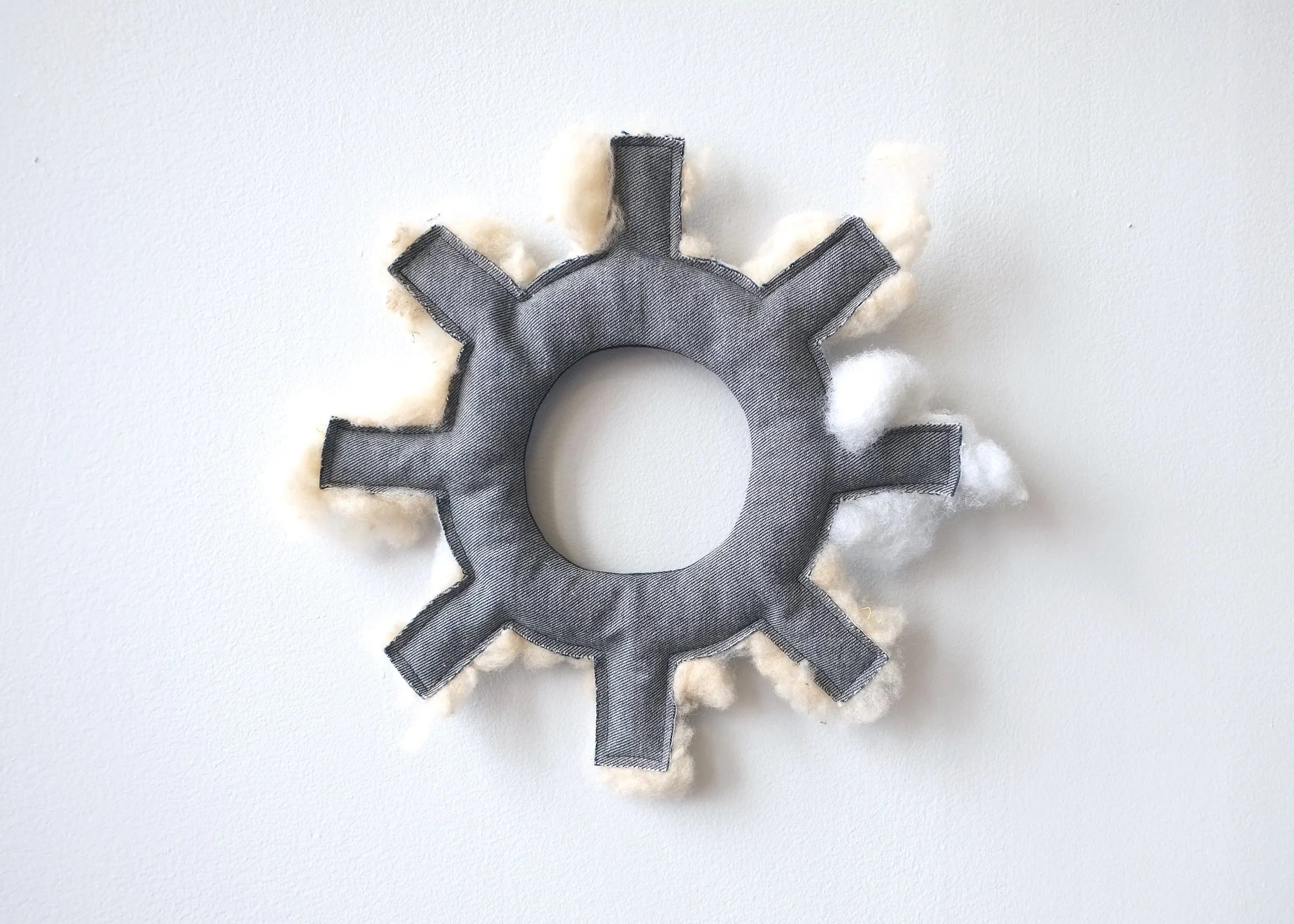
Sunbreaker,
2025
Denim, raw wool, polyfill
15” x 15” x 1”
KB: So, with such a strong willingness to explore and be in nature, were there other people doing similar things in their work? Were there artists or naturalists that you looked towards or were you just doing your own thing?
RS: I did a docent program at a museum called the Aldrich Museum of Contemporary Art around eighth grade and I learned to be a kind of museum guide. I was this very eager kid that liked art, but didn't really know the things I liked about it yet. It was my first encounter with contemporary art and people being willing to really explain to me what it is I could be seeing. There was one artist in particular that interested me. It was Mark Dion, and his work, if I could explain it, is museological in form. It’s made in an effort to express concepts of science. Science was another big influence for me and a bigger influence I skipped over before was George Washington Carver. Learning about his work in my school curriculum was great but to find out that he loved the world in such an unconditional way and wanted to do so much for the public without real reward of any kind left an impression.
He was a naturalist and he painted watercolors of the specimens that he was around like flowers and similar things. He spent a lot of time in a garden and I was like, that's me. I thought as a little kid, that's the life I want. That brings me back to being in that museum and seeing Mark Dion's work very much adjacent to that sort of aesthetic. He's using things like found cabinets and shelving and scientific naming conventions. He does a lot of big projects that involve big teams and excavating and archeological dig sites and stuff. I was thinking, that is rad knowing that can be art.
KB: That's really cool. I wrote Mark’s name down so I can look it up afterwards. Also, to your point about George Washington Carver, I recently found a kid's book on George Washington Carver's life. It had beautiful illustrations, and it was his story about him being a scientist and an artist and I was like, this is so cool. I didn’t know a lot of the stuff I was learning because in school they only talked about him being the inventor of peanut butter. When I was actually reading through it, I was like, wow, like seeing him as an actual artist is pretty cool
RS: He's a botanist, you know? He was a scientist that was relied upon by a lot of big intellectual minds. It's just another person that was around that time whose stuff I was looking at. I was really interested in it, the kids’ books at the time were really top tier. I loved The Magic School Bus and Ms. Frizzle. Prior to the docent program, I was noticing things illustrated so clearly I can still picture them. I think as a kid it was fun, not just the concepts, but the way that things were rendered.
KB: Speaking of the things that you were interested in during your childhood, I wanted to understand what inspired you to explore the subject in your work? When you are creating your art, what objects and materials do you lean towards the most?
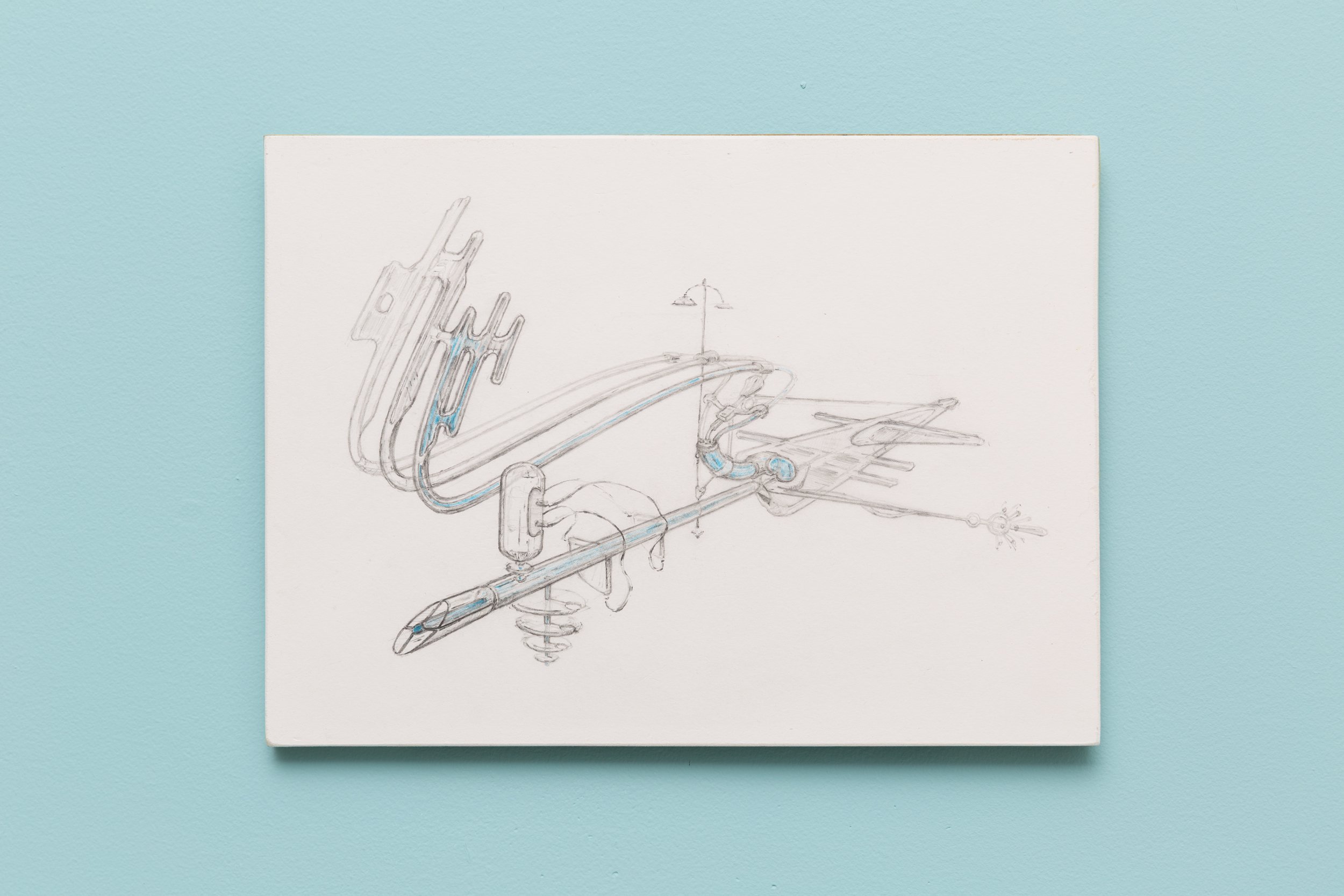
Pneuma, 2026
Graphite and colored pencil on mat board
11 1/2" x 8 3/8"
Photo Credit: Ian Byers-Gamber
RS: Yeah, it's a great question. I often talk about abundance as opposed to scarcity, because I don't think that's the world that we live in. We have more than enough, the earth provides 10 times over. So, I'm always interested in what's already here and in the kind of built sense in terms of our hand in the world as humans go, the things that I'm drawn to are very accessible materials. They are the things that you would encounter on the street. They're quotidian and are often like hardware store fodder. That’s the type of stuff that finds its way into my studio and so I think what's being sort of taken from my sculptures is that the visuals that people recognize are from materials and objects that are present in their own lives. I'm making a piece, an object with a bunch of used tea bags right now, to me it's representative of how to physically process waste and interrogate how we think about it. Thinking about the landfill trash model that we've created, that is one of the least perfect things about us. It's such a failure in many ways. I feel like in a lot of ways as an artist, one of my jobs is to present an alternative, to just give a different way to maneuver with material you may have seen already, something that is very familiar to you.
KB: Where do you source most of your materials for your practice? Are they mostly found objects?
RS: I'm working with stuff that you could get from pretty much anywhere. A lot of it's found objects, I find on the street, and paired with things I’ve created in response to an object or material. With the spear, for example, the inspiration for that was really multifaceted. The fact that you talk about everyday objects, the spear itself, to me, is almost ceremonial. It's this big, clunky representation of what a spear is because it's massive. It can't really work the way it's intended to, so to me it was an almost decorative sort of thing, like the type of thing you would have on a mantle or displayed somewhere.
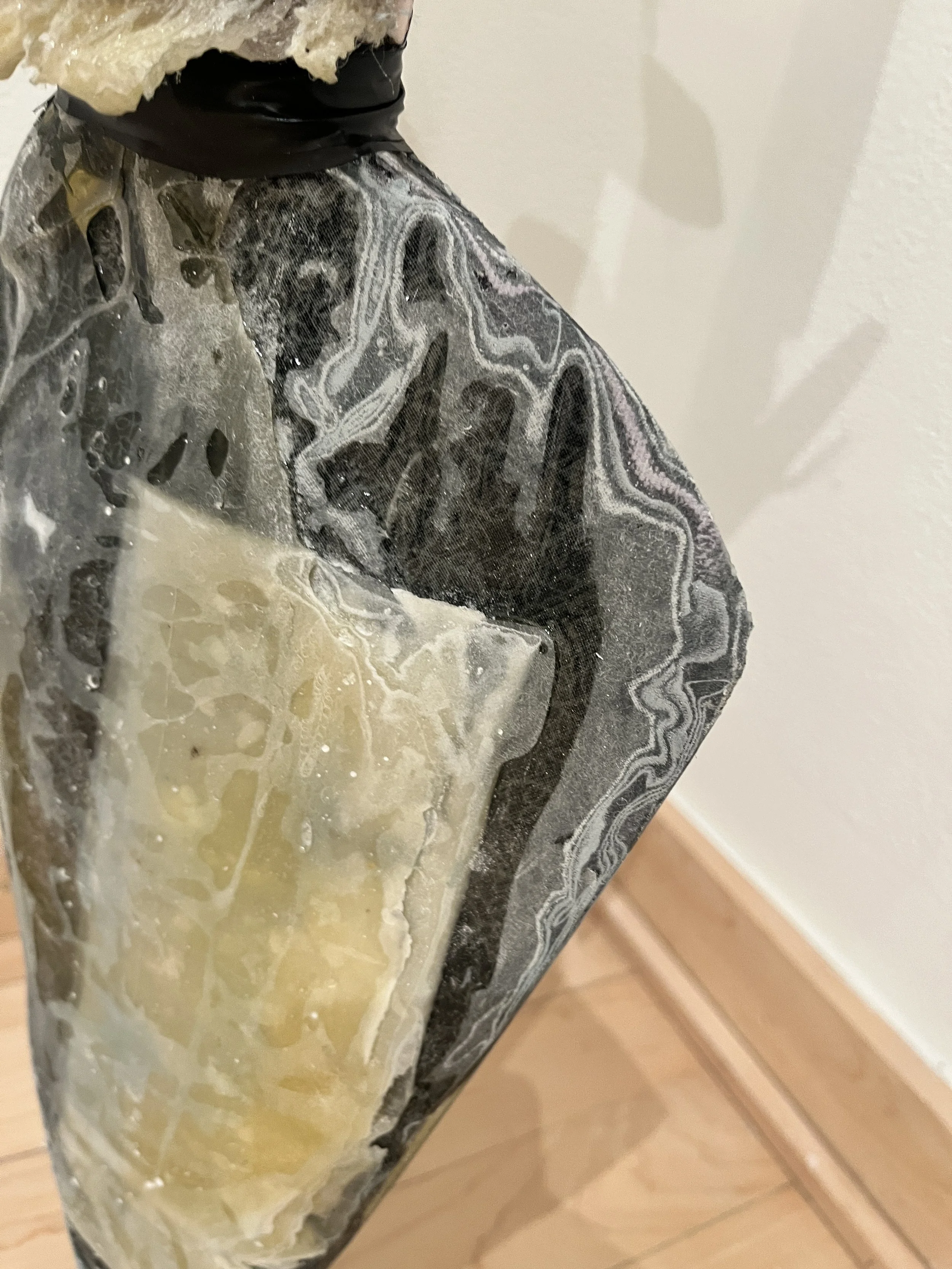
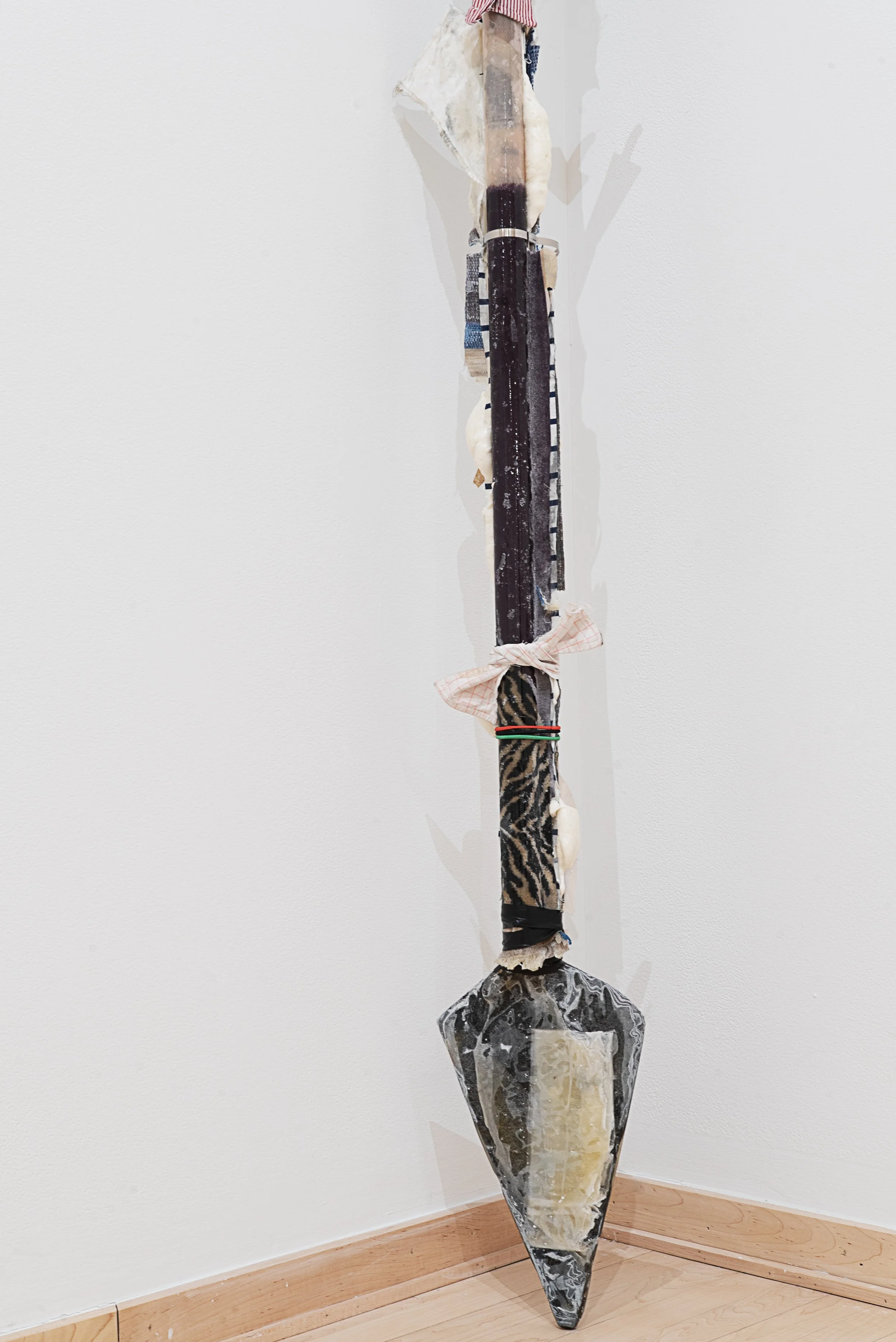
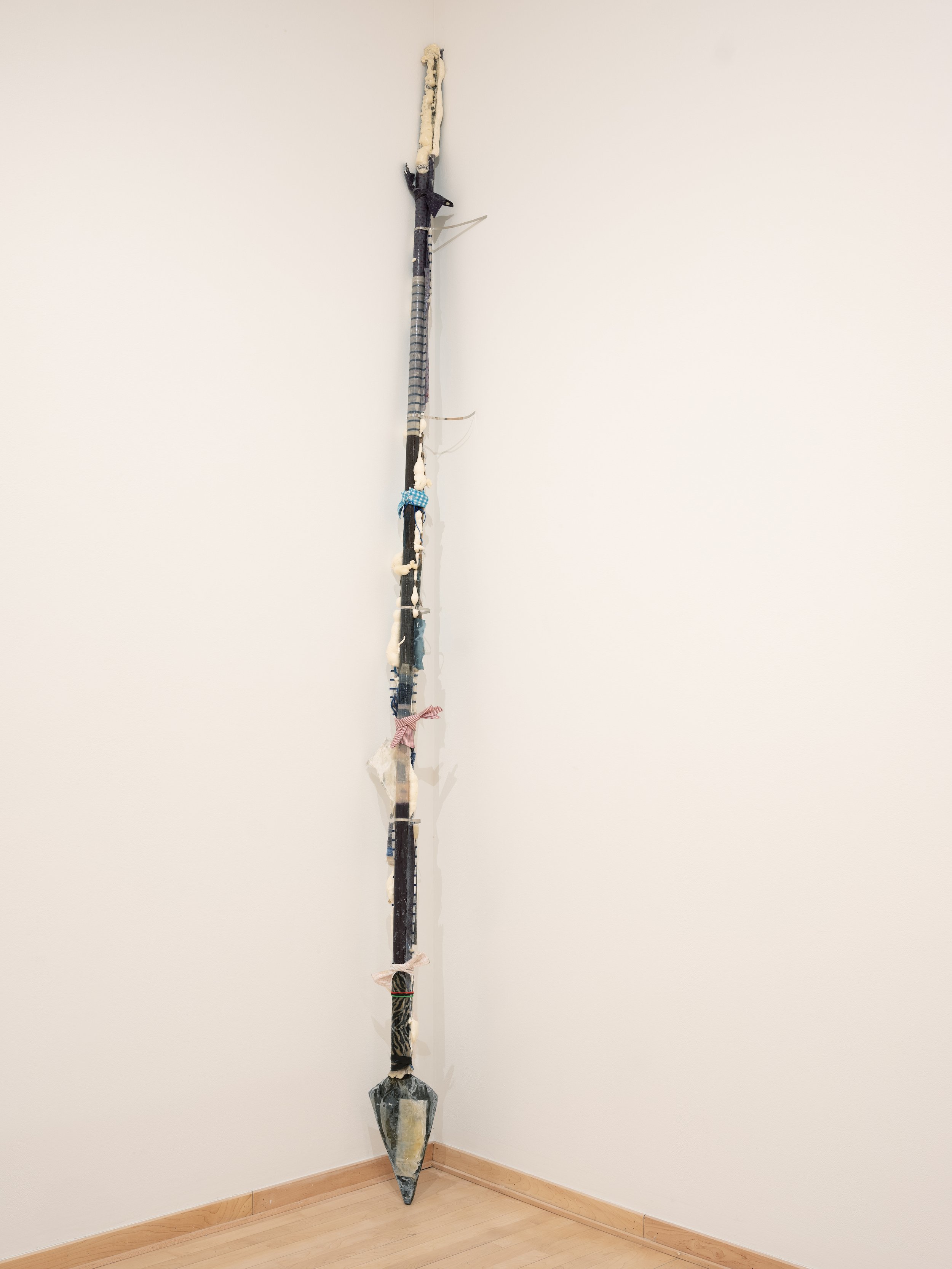
I’ve come back to you, 2024
Found fabric, ecopoxy, expanding foam, dowel, brass rod, electrical tape, cable ties, hardware
Size: 23” x 10” x 2 1/2
Photo Credit: Will Toney
It made me think about this concept that I deal with kind of personally a bit about lost identity. My family has Bajan roots on my mom's side. Our Barbadian lineage is known, but not really the most culturally present, at least from my perspective, but I'm really fascinated by that type of self-discovery. When I thought about my family, I thought about the Barbadian flag and the Trident on it. What’s distinctive about it as a symbol is the way it’s been severed just beneath the prongs. It’s presented this way to signal a break—a deliberate severance from British and colonial rule. The gesture is intentional: a declaration that we are no longer that, that we have moved on, and that this is how we choose to carry ourselves now. It’s a posture of intention.
The spear leaning in the corner is titled “I’ve Come Back to You.” I often place it in corners because the work is about remembrance—about finding comfort within one’s own culture and drawing strength from knowing where you come from. It’s constructed from found fabrics that were pressed into a mold with Ecopoxy to create a rigid, bound together structure.
KB: I was also curious about your creative process. When you’re in the studio working on new projects, what does that environment look like for you? Are your pieces planned out in advance—shaped by inspirations like the history of the Barbados flag and the cultural stories you’ve researched—or do you prefer to work more intuitively, letting the process unfold as you discover new materials and objects?
RS: It’s really a mix. I keep a strong drawing practice—my sketchbook fills up quickly with illustrations, notes, measurements, and little bits of writing or thoughts. Even though text doesn’t always show up in my final work, getting ideas out on paper helps me understand what I’m making. My practice feels very mutable, so I let ideas come out however they need to.
In the studio, I move between different kinds of work. Some days are just about laying things out, prepping fiber, washing or scouring materials, pressing seams, or seam‑ripping—just getting close to the materials. Other days I’m drawing, sewing, or building something sculptural. I bounce around a lot, which is just how my brain works. I’ve gotten better at prioritizing what needs attention in the moment, even with time blindness and all the other neurodivergent chaos. Switching tasks keeps the work exciting; the materials respond to me, and I respond to them.
Tools matter too. My industrial sewing machine has been a game changer—quiet, reliable, and able to handle whatever I throw at it. I’m often on that thing, just workshopping ideas and seeing what sticks. Honestly, that constant flow in the studio is how I know I’m doing what I’m supposed to be doing.
KB: My last question is what message do you hope that your art can share to those who may come across or view your work?
RS: That's such a great question. I think just that, going back to this idea of abundance, we have enough that's out here. You can make art in so many different ways and a lot of it often relies on your dedication to yourself and your practice, like pouring into yourself. You do that and your work will say all you need it to say.
I hope that my work can inspire things even beyond art. Seeing people want to fulfill their interests out in the world. I'm very hopeful about the world. I think we are very lucky to live on this rock, in this timeline. There aren't any other options for us. So it's really crucial that we take care of where we are. So, I hope that my work provides some introspection for folks and makes us look at the world. I am, with pretty much with every move I make, and I think that's why some pieces take me so long. I'm constantly asking myself why something is there—every single time. From a color to a surface to the thread type I'm using, nothing is accidental.
More than anything, I hope my work inspires people to slow down a little and really spend time with what they're seeing, because art deserves that. Art, in a lot of ways, is a representation of our best—what we do as humans. Not just what I make, but art in general.